Showing posts with label New Jersey. Show all posts

Tuesday, August 13, 2013

Pequannock residents share Holocaust experience in Cedar Crest documentary

The choice in front of 16-year-old Paul Graf Loewner was stark: escape through the window, dodge the inevitable barrage of German bullets, and hide out for however long the war continued… or go with the Nazis who’d walked up to his door.
Paul Loewner

"My mother wanted me to escape through the window, and I was ready to go, but my father said it was too dangerous," Loewner said last week as he sat in a cushioned chair in the Cedar Crest Retirement Community’s TV studio. "I couldn’t do it…but I should have listened to my mother."

Loewner did not escape, and he and his father were herded into a cattle car and sent from his small village outside the Slovakian capital of Bratislava to the Sachsenhausen concentration camp in Germany.

Eventually, the Nazis tried to separate them so they could be put in different cell blocks; when a scared Loewner wouldn’t let go of his father’s hand, a guard struck him behind the ear and knocked him down.

He would see his father just a few more times before being sent to Buchenwald. After that, he never saw him — or his mother — again.

"They probably killed him the way we watched the others [get killed]," he said, looking away.

He scraped by in the dismal camp, seeing other inmates being starved and shot and murdered, until the American tanks from General George Patton’s Third Army liberated the camp on April 11, 1945.

"We were safe. We were liberated," he said with a slight accent, a jubilant smile crossing his face. "I thought it was the greatest happiness in my life up to then to be liberated."

Although the comfortable TV studio is a far cry from the cold floor of a cattle car, after seven decades, Loewner finds his memories are vivid.

And it’s memories like those that he, along with 18 other residents from the retirement community, have shared in the 90-minute documentary about the Holocaust entitled "Never Forgotten."

It was Cedar Crest producer Mike Dygos’ first feature-length production, and he called it a "huge accomplishment," especially because he already knew so many of the residents.

"To sit here and hear these stories coming out of these residents’ mouths — we see these people everyday, we see them in the hallway, and then all of a sudden they’re telling this crazy story that you can’t believe anyone would be able to survive… To attach a person you know to a story like that, it really makes the Holocaust real," the 26-year-old Dygos said.

Producer and coordinator Larry Curan, also 26, agreed, and said that learning about the Holocaust from books, as he had in school, was nothing like hearing the stories told in the voice of one who’d lived through it.
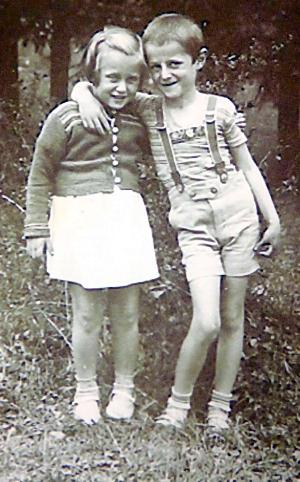
Loewner, as a child, with his sister

"That’s why this piece is so powerful: because every single one of these is a first-hand account of what actually happened," he said. "It was amazing to hear some of the things that we heard people say."

Producer Doris Sinofsky, age 85, was in high school during World War II, and said that she, like most Americans, had no idea that the Holocaust was even going on in Europe.

Although she would eventually marry a Jewish man, she still hadn’t heard the stories of the concentration camps in such an up-close-and-personal way until she watched the interviews being recorded.

Sometimes, she said, she had to leave the studio during the filming — especially when the women told their narratives.

"The things that they went through was just beyond comprehension. It was awful," she said.

The producers agreed that the hardest seat to be in, however, was not in production — it was on stage, across from the survivors, prompting them to relive the greatest horrors of their lives. The man who occupied that seat, they said, quickly became the axle around which the project revolved.

Bert Moore, the community’s 63-year-old pastoral ministries manager (a position he described as "essentially a chaplain"), came to Cedar Crest five years ago after a 25-year career as a Navy chaplain, and had already formed relationships with many in the Jewish community. After putting out the initial word that the production team wanted volunteers to speak about the Holocaust for a documentary, it only seemed natural that he would conduct the interviews.

"It kind of fit right in," he said.

In the end, about 35 hours’ worth of interviews were recorded, and all three producers were effusive in their praise of how Moore handled what could have been a difficult job.

"For someone who has never done interviewing on TV before, he really fit the role perfectly, and it had to do with his compassion," Dygos said. "Him being able to ask the right questions, and then listen to the people and be able to off their stories… We got a lot of things we really weren’t expecting."

Sinofsky agreed, and said that there were several points where, during a given interview, she would think that there was simply nothing left to say — and then Moore would ask a poignant question and the floodgates would open once more.

The chaplain simply said he tried not to make the residents feel uncomfortable.

"I don’t know that I necessarily thought it through that much," he said with a laugh. "I guess it was that I would listen to their story, and ask a question that would take them to the next step — if it seemed to me like there was a gap, I would try to bounce back and say, ‘What happened here?’"

It was also important, he said, to focus on not only the residents’ experiences in the Holocaust, but on the post-war years as well — when they immigrated, when they married, what they did for a profession, and how they ended up at the quiet retirement community in the woods of northern Pequannock. Their resilience throughout their lives, he said, was astounding.

"The thing that kept coming back to me was how amazing it was that they could have this kind of life experience, and be able to put that behind them, and move on, and have successful lives and raise families," he said. "To see how they could survive that, and turn their lives around, and I would say contribute to society in a very positive way — it was such a huge dichotomy."

There seems to be quite an audience for that sort of message. Sinofsky said the documentary has already been sent to a number of libraries and schools, and the Holocaust Memorial Museum in Washington, D.C., may eventually store the dozens of hours of raw footage. "Never Forgotten" has even won a Telly Award, which honors the "very best film and video productions" from local, regional, and cable TV," according to its website.

But perhaps the most important part, said 84-year-old resident Leopold Lowy, is what can be gained by exposing the public to the horror of the Holocaust: the assurance that such a thing will never come to pass again.

A Czechoslovakian native, he lost both parents during the war years, and was on his own in a Jewish orphanage at age 12. Later, he was sent to the infamous Auschwitz before ending up at the Buchenwald concentration camp.

A lifetime later, Auschwitz remains an open wound.

"No word, no book, no pictures can describe hell on earth… That’s all I have to say. Buchenwald was very close to it, but at least in Buchenwald, they may have starved you to death, worked you to death, but not gassed," he said, his face darkening for a moment. "But this is all past. I came here, and I started a new life… You can’t live in your past. You have to look to your future."

Email: janoski@northjersey.com

http://www.northjersey.com/community/218318131_Pequannock_residents_share_Holocaust_experience_in_Cedar_Crest_documentary.html?page=all

Thursday, August 1, 2013

In Paterson, that's just the way things go

When the massive brick wall of a three-story Ryle Avenue mill collapsed on July 16, sending the roof tumbling through two floors and debris shooting into the road, it instantly became the perfect metaphor for its hometown.

The building, although it was a part of local history, had been slated for demolition because it lacked structural integrity. But, as is so often the case in the city's seized-up bureaucracy, the process stalled, and so there it sat, a rotting reminder of Paterson's once-fearsome industrial muscle, dying with one last howl as Father Time finished the job that local officials could not.

Once, mills like that made up the heart of a New Jersey manufacturing juggernaut that harnessed the power of the 77-foot-high Great Falls to produce textiles, firearms, locomotive parts, and so much silk that the word found a home in the city's nickname.

And, like so many in the state who have some Italian blood in them, my family roots wind their way back to those hulking brick-and-mortar behemoths along the Passaic — growing up, I heard many a story about my own great-grandfather, a sharply-dressed, wealthy man who owned one during Paterson's heyday.

When I was a kid, I would try to imagine what it looked like during his time, when it was a thriving boomtown of shops and tenements fueled by the energy of thousands of European immigrants streaming off the ships every day. All I could see then, through the thick glass of a car windshield, was a shattered shell that looked moments away from imploding.

But hey, it was the 80s, wasn't it? White flight, urban blight, the crack epidemic, and outsourcing took their toll, and finding a safe downtown anywhere was difficult. Hoboken was in shambles, Newark was long dead, Jersey City was rough as ever. Times Square was filled with hookers and pushers and peep shows, and the Bronx, with its crumbling buildings and tagged up facades, could have been Beirut's stunt double.

Years later, though, there's less of an excuse. Jersey City is rebounding, parts of Newark burn bright, and Hoboken is exclusive. Times Square is again the glittering jewel it was meant to be, and even the Bronx has made headway.

And then, barely limping along, there is Paterson, torn up and hemorrhaging blood from the twin bullet holes of crime and corruption.

Where is the redevelopment? Where is the falling crime rate? Why, after all these years and all these millions spent, has nothing changed?

People are terrified to even drive through, and cringe when their GPS sends them across the river` for a "shortcut." Just last month, a kid from my hometown died in the street from a gunshot wound to the neck in a neighborhood described as "the Wild West," and days ago a man was arrested for nonchalantly carrying a fully-loaded machine gun on East 16th.

The state still runs the utterly failed school system, the police force has been gut-punched by massive cutbacks, and the murder rate is unchanged. All the while, the city administration, instead of addressing the myriad of problems, recently announced that it's ready to move ahead on an initiative to — get this — debut a line a of bottled water that would be named after the Great Falls.

What the hell is going on?

Undoubtedly, some will say that I'm focusing on Paterson's many negatives at the expense of its positives — and they'd be right — but that's only because I badly want this madness to end.

And don't get me wrong, I don't know how you fix things; I'm not a municipal planner or a police chief or a mayor. But I do know that if it can be done in New York, it can be done anywhere, and that a real, solid effort to turn the city around must be made — and soon — before Paterson starts challenging Camden for a title that it wants no part of.

Otherwise, it will continue its long descent, and decaying silk mills will be the least of the worries.

Email: janoski@northjersey.com

http://www.northjersey.com/news/217869481_In_Paterson__that_s_just_the_way_things_go.html?page=all


Tags: Paterson, Silk City, Great Falls, New Jersey, History, Politics

Tuesday, July 23, 2013

New Jersey reenactors take the field for Gettysburg's 150th anniversary

An hour-and-a-half before the searing July sun breaks the horizon over the rolling fields of southern Pennsylvania, a bugle call cuts through the darkness to stir a still-sleeping army from its slumber.

Slowly, ghostly figures tumble out of their canvas tombs to light the fires that will boil their morning coffee and cook their breakfast bacon. Before long, after more snooze-button-style bugling, more men emerge, buttoning shirts and pulling on blue woolen jackets before the morning roll is called.

It's not the first time that these fields, which are located just a few miles northeast of the small village of Gettysburg, Pa., have seen this spectacle, but if things don't change soon, it might be one of the last.

Undoubtedly, Civil War reenacting is a bit of an odd pastime, and few who are not in "the hobby," as it's called by those in the know, can understand what drives thousands of men, women, and children to dress up in Victorian era clothing to party like it's 1863. Tell someone, with any degree of seriousness, that you're a reenactor yourself, and you can quite literally watch the look on their face change to what can only be described as a cross between incredulousness and pity.

In reality, though, this peculiar pursuit is much closer to a massive theater production than many in the public realize, and it's designed to breathe temporary life into the shadows of history for a few short days to give citizens a lesson they couldn't glean from their high school teachers.

And it certainly does that - from the loud, flea-market atmosphere of Sutler's Row to the sulfur clouds floating over the swarms of rifle-toting men that fight out the battle, the sights and sounds offered by the 150th reenactment of the Battle of Gettysburg could not be replicated in any classroom.

Sadly, though, as the current flock of reenactors continues to gray, the future of this undertaking may be in danger. Although about 8,000 living historians make the trek to the hamlet 40 miles from Harrisburg, it's a far cry from the now-legendary 135th anniversary, which had a remarkable 40,000.

On top of that, a civil war has erupted within the hobby itself as a growing number of reenactors - called "campaigners" or "progressives" by their mainstream counterparts - have split away to form their own groups that take the term "living history" to an extreme. They held their own event the weekend prior, and this not only cut into the number of participants at the official reenactment, but led to widespread confusion amongst the general public about which show is the "real" one.

This combination of an aging population and brutal internal politics may be creating a death spiral for the hobby, one that many, like West Milford's Mike Belgie and his reenacting compatriots, want to avoid at all costs.


A dying breed

For years, many thought that Gettysburg's sesquicentennial anniversary would be the hobby's moment of glory, especially after the triumphant 135th saw tens of thousands of Union and Confederate troops take to the field to perform a raucous full-scale recreation of the infamous Pickett's Charge.

And, although numbers aren't crucial to the reenactors themselves - Belgie says they often enjoy smaller performances more than these "mega-events" because of the increased flexibility and decreased stress - there was a sense that the 150th would draw far more participants than ended up coming, and the low turnout has several wondering if this anniversary was a "coup de grace" instead.

But still, most believe that at least one of the two major engagements held on Saturday, July 6, was a success. Without the numbers, they aren't as muscular as they perhaps could have been, but they are active and intense, and every unit gets to "burn some powder," as they say.

Belgie, 57, is an 18-year veteran of this hobby, and is reasonably high on the reenactor food chain; as a major, he fleshes out part of the body of a half-dozen men who serve on the staff of General Tony Daniels, commander of the Union Army's 2nd Division.

Tall and skinny with gray curly hair, a gray goatee, and a set of glasses permanently affixed to the bridge of his nose, Belgie is a laid-back sort who makes his living as a photographer but is also an ex-Deadhead, ex-security contractor, ex-everything kind of guy.

Daniels, 66, might be described as his opposite. Shorter and thicker, with a weather-beaten face and a dark beard, he bears an uncanny resemblance to Ulysses S. Grant and was born in Newark on 85th anniversary of the Battle of Antietam. A Verona native, he taught history for years in Jackson Township, and speaks carefully and deliberately. The letters "SPQR" - the initials of a Latin phrase once emblazoned on the standards of the Roman legions - are tattooed across his left shoulder.

The mercury rises quickly Saturday morning, and as it does, there is some doubt among Daniels' staff as to whether they, or many of their men will participate in the afternoon battle, which is slated to start at 1 p.m. As the hour nears and other units assemble, that doubt strengthens as the mercury climbs past 90, and although a few gear up, Daniels, Belgie, and many of their 800 or so reenactors don't leave the shade of their tents.

At this point, it's far hotter for the recreation than it was for the actual engagement.

The battle kicks off 20 minutes late and is something of a mess from the start. Although the artillery cannonade is fearsome, the main infantry battle occurs over a quarter-mile from where the spectators sit and is blocked by a grove of trees.

As the standing-room-only crowd follows the fight, many end up crashing through a camp and breaking through a thin line of woods before coming out far too close to the action for the comfort of either the reenactors or the event staff, and several women on horseback ride the length of the unruly line, screaming at the onlookers to clear the area. Their efforts are met with a mix of begrudging acquiescence and, in some instances, belligerence, and in the end, it's only the threat of police intervention that accomplishes their goal.

Afterward, back at the cluster of five or six tents that makes up the 2nd division headquarters, the few officers who took the field reveal that the scenario strayed so far from the script that it eventually turned into an impromptu "tactical" - an unscripted battle that is more like living chess than a well-rehearsed play.

"It went well," one officer says, grabbing a Yuengling out of the wooden cooler marked "Adams Express."

"Yeah? I heard it was a cluster-[expletive]," Daniels replies quietly.

"Well... We had a small but effective force," the officer says with a grin. "I think it went very well. The men were happy."

Lunch is served shortly afterward, and a lazy afternoon passes as black ants crawl across the table and horseflies abuse everything with a pulse. The staff drinks cold lagers while discussing everything from (of course) reenactor politics to New York Giants football (Daniels had season tickets for years). Nearby, a band plays poor renditions of rarely heard songs like "Battle Cry of Freedom" and "Bonnie Blue Flag" on the violin.

By the time 5:30 p.m. rolls around, though, the staff is ready to get moving - the sun has tumbled lower in the sky, and a slight wind has made the heat more bearable.

As the men - along with the occasional woman - form up, Daniels mounts Gabriel, the massive 2,000-pound black horse that he rides into battle, and takes his place at the head of the line. He is an imposing sight.

Belgie used to ride, he says, but his back no longer can take the abuse, and a couple of close calls with an unbroken steed a few years back means that he now walks into his fights.

This time, the reenactment appears to go off without a hitch. Few of the officers know which particular piece of the battle they're reenacting, but they know the script and stick to it as Union troops take their positions in a dark woodline at the crest of a steep hill. The Southerners meet with success initially as they fight their way up the slope, but the closer they get to the top, the more blue lines step forward out of the thick leaves and ambush them.

By the time they reach the crest, many have fallen, and the Southerners realize that, having marched into the open end of a horseshoe, they're being enveloped by Union troops who send volley after volley into their flanks.

The federal fire intensifies, and cannons boom in the background. Understanding what the man next to you is saying is, at times, impossible, even though reenactors use only partial charges; if they were using real cartridges, every rifle would be several times louder, and the artillery would literally be deafening. The real battle, it's said, was heard 140 miles away in Pittsburgh.

By the time the bugles blow the "cease fire," it's clear that this is a resounding victory for the Union. When the voice of a woman singing "God Bless of America" clamors out of the loudspeakers, all hats come off, and the thousands on the field fall silent.

After the battle, the feeling in camp is markedly lighter, and the officers smile like a boxer who's just finished his bout.

"The boys had fun today," Daniels says to no one in particular. All nod in agreement.

But, while it was a good reenactment, it is clear that it could have been far larger and far more impressive if more men had shown up.


A 'general collapse'

Hours later, Belgie sips from an aged tin beer stein as he speaks about the day's battle and the divide that's driven down participation. What we're seeing, he says, is not an implosion of the reenactor community - it's more of a "general collapse."

The campaigner group, named the "Blue-Gray Alliance," had maybe 8,000 in its reenactment the week before, but regardless, only about 2,000 would have actually participated in this event, Belgie says. The rest have little regard for mainstream events, which tend to stay close to the history books on the battlefield, but are more laid back in camp. The site of women in the "company streets" (the lanes between the tents), enlisted men with tents larger than they should have, and cars and trucks visible in the distance as there are here would be unacceptable.

Cell phones are banned, coolers aren't allowed, and beer is a no-no. Spectators, Belgie says, are more of a bother than a blessing to them.

"They would rather do it for the reenactors, by the reenactors - that's their motto," he says. "They don't want modern intrusions... You actually cross a time line, and when you cross that line, it is 1863. This is Gettysburg."

He's participated in events like this - most reenactors have at one point or another - but the rules get tiresome, and truly living in the field like it's the mid-19th century is less than pleasant if you're strict about it. And one can't help but get the feeling that mainstreamers roll their eyes at the thought of being "authentic."

"Authentic? The last authentic Civil War soldier was (Alfred) Woolson, and he died in 1956," Belgie says. "Everybody since then is just a reenactor. We're just recreating history so the public gets some education that they didn't get in school."

Pennsylvanian Carl Popadick, another long-time member of Daniels' staff who also portrays pirates, Revolutionary War soldiers, and everyone in between, is a bit more blunt about his feelings.

"They just don't give a [expletive]. They don't care if they teach anybody anything. They didn't want spectators, but to pull something off that size, they needed spectators to pay the way," he says. "They're just using the public - they don't care if they have a good sightline. They don't care if they're comfortable in the field or they have water. It's, 'We got your 20 bucks to get in, so we can have an event for ourselves.'"

Daniels agrees, and it's likely the history teacher in him speaking when he calls the campaigners "exceptionally selfish." And for those that sit around his camp table, drinking beer and whiskey and smoking cigars by candlelight late into the midnight hours, this blatant disregard for the public is a cardinal sin.

"We have a different slant in that we try to portray it as historically accurate as possible for the public to see. Those guys are just in it for themselves," he says. "The event last weekend, they had a handful of spectators, and they didn't care. They didn't even want [them]."

And the idea that the campaigners, who seem to have an increasing amount of influence, are trying to wrestle the entire hobby in that direction, is intolerable, even more so because they're meeting with some success - two years ago, no mention of this war between the reenactors was heard around anyone's table.

Now, it's a constant topic of conversation.


'The kids today are air-conditioned'

The other thing that worries the old guard is that the youth don't seem particularly inclined to take up the mantle that is slowly being abdicated by the graybeards. With many of the current crop of Baby Boomer reenactors reaching the age of 60 or 65, coming out into the field for a weekend isn't an option anymore, Belgie says.

"It's just physically impossible, and in fact, it's dangerous to your health," he says.

New members are needed if the hobby hopes to survive, because guys like him are "gettin' kind of tired."

Where that new blood comes from, however, is still unknown, and with kids spending their free time in front of iPhone screens and Xbox games, convincing them to come out for a weekend to learn to shoot a black powder rifle is harder than one might think.

"The kids today are air conditioned... They're not outdoor people," he says. "I could go to any high school in the country and say, 'We're not gonna' fight a battle, but we're going to go out and camp... You're going to have a rubber blanket, two wool blankets, it'll be a 90-degree day, you're going to put on three layers of wool and carry a musket that weighs 18 pounds,' and they're going to look at me like I got three heads."

Southerners tend to have better luck keeping their numbers up, and Belgie attributes this what he considers a mix of a "good propaganda system" that makes them believe that the South will "rise again" and the anti-government tendencies of its people.

Add to that the relative oddity of actually becoming a Civil War reenactor - which Belgie says has always earned him queer looks, no matter the year - and it's a tough sell to the Millennials.

Nearly everyone on Daniels' staff echoes the same sentiment; they wish they could get their kids to join them, but it rarely happens.

Belgie also notes that they've tried to help African-American regiments, such as the United States Colored Troops (USCT) and the 54th Massachusetts, recruit, but there's been a dismal response - even though 180,000 black soldiers served in the real Union ranks.

"We've tried to help [those units], but they just can't get any interest out of their communities," he says. "They're like, 'You're kidding right? I'm not doing that.'"

Daniels admits that the low turnout for Gettysburg is "a bad sign, no two ways about it," and worries that the hobby might someday shrink in popularity to that of, say, Revolutionary War reenacting, which was immensely popular during the 1970s but is now a shell of what it once was. But he seems more optimistic than Belgie, and believes that a TV miniseries like Ken Burns' 1990 PBS special "The Civil War," or a new movie in the fashion of "Glory" or "Gettysburg" could kick start things again.

"We are a culture that is attuned to what we see on television," he says.

The next couple years will be tough, though, as many old-time reenactors who stuck around just to see the Gettysburg sesquicentennial will now likely retire, he says.

"Right after this event, it's going to be like you pulled the plug in the bathtub. You're going to lose probably a quarter of the guys who are here, because they were staying in it for this," he says. "This is going to have a marked effect on reenacting."

There are some connections that will continue regardless, though, and Popadick points out that people are still closer to the Civil War than they ever were to the Revolution because of heirlooms like letters, Bibles, and other artifacts that are still being passed down within families.

"[They say] 'Oh, I still have my great-grandad's Bible, his glasses, the hat he wore.... So that's still getting passed down, and that's going to help keep this alive," he says.

Daniels also notes that over the last two years, he's seen more young kids around the camp than he used to, and there's always the hope that as the economy improves, reenactors who are either out of work or can't take off the necessary days may begin showing up again. Also, better paychecks mean that more beginners might be inclined to spend the initial $1,500 that it costs to outfit oneself with the appropriate gear.

"The economy has a lot to do with it, the price of gas has a lot to do with it, the weather obviously has a lot to do with it, but I'm feeling a little better about the hobby now than [last year]," Daniels says. "Not like super-optimistic, but I'm thinking, 'Hey you know what...'"

Nothing has been formally proposed among the reenacting hierarchy to prop up the faltering numbers.


A thing worth saving

Ask a reenactor why, what with its back to the ropes, "the hobby" is worth saving, and you'll get a variety of answers.

Daniels is of the opinion that it's important to educate the public on its history, and points out that the crushing multitudes of participants and spectators do, in fact, boost the local economy of whatever town an event is held in.

Popadick says it's important because in a nation that's famously ignorant of its own past, knowing what happened before helps us understand what's going on today. People in the British Isles, he says, not only know what happened 300 years ago, but understand that it transcends the centuries and still affects current events.

In America, that's not the case.

"Our average kids don't know anything about our history, or what happened in any time period," he says. "And what happened in the Civil War definitely affected the way we live today - it literally made America."

Plus, he points out, where else could a conversation like this even take place outside of this atmosphere?

Belgie's answer is perhaps the most revealing. It was the family stories about his great-great grandfather, William C. Louderback, a coal miner who served with the 79th Pennsylvania Volunteers, that piqued his initial interest in the war. Louderback, after all, had been a part of General Sherman's infamous "March to the Sea," which burned its way through Georgia in 1864, and saw action at several brutal battles.

But it was something that happened after Belgie's first night in the field nearly 20 years ago that cemented his place in the ranks.

He'd been dropped off that weekend by his "better half" and told, more or less, "See ya Sunday." When he arrived at the site, the reenactors pointed to a low "dog tent," told him that's where he was sleeping, and gave him a wool uniform to wear.

The next morning, he says, he awoke to a scene that was out of place in time.

"I looked out, and there's five guys sitting around a fire, they've got their pipper on [it], they're boiling coffee, they got the little pans out and they're making bacon, and I'm like, "[Expletive], this is what my great-great-grandfather saw,'" he says. "That's it. You know what I mean?"

Suddenly, he chokes up.

"God, that was a long time ago," he says quietly, sending a thousand-yard stare into the distance.

"You can read a book," Belgie says, pausing momentarily. "It ain't the same....We can't lose this. And I don't know how we're gonna save it, but there's got to be a way to do it."

Whatever their plan is, they'd better start soon. Or else, like the souls of the men they portray, they may end up haunting these fields, wondering what went wrong, and wishing they had one last chance to do it differently.

Email: janoski@northjersey.com

http://www.northjersey.com/community/history/more_history_news/215471381_New_Jersey_reenactors_take_the_field_for_Gettysburg_s_150th_anniversary.html?page=all

Monday, February 25, 2013

Mayor says switching power utilites beyond Pequannock's reach


Nearly three months after township residents spent a long two weeks without electricity due to Hurricane Sandy, it’s becoming more and more apparent to local officials that for better or worse — and despite their best efforts — they are going to be stuck with Jersey Central Power & Light (JCP&L).

Linemen from out-of-state utilities swarmed to New Jersey in Sandy’s wake to help with the cleanup from a storm that left millions without power in the tri-state area. Outside Plant Tech linemen Joe Noto, Kevin Sweetman, and Chris Rockey saw trees on Green Hill Road near the corner of West Shore Drive during the aftermath of Hurricane Sandy. Several towns, unhappy with the way their local utility handled the storm, have sought to change electric providers.

It wasn’t just the extended outages from the scores of felled trees that frustrated officials, said Pequannock Mayor Rich Phelan, it was the lack of communication about where restoration efforts were that led to the town’s disgust with its electrical provider.

As a result, a number of local towns, including Pequannock, made informal inquiries as to what it would take to switch utilities, but it appears the game of musical chairs will end before it begins because of what Phelan called the "mind-boggling" difficulties associated with it.

It was during a Jan. 3 meeting with state Board of Public Utilities (BPU) President Bob Hanna, Phelan said, that he was told that the town itself would have to buy all of the electrical infrastructure — including the poles, substations, and wires — the cost for which could run into the tens of millions of dollars.

Following that, the town would have to petition the BPU to release it from the franchise agreement that JCP&L has on this piece of the state, and BPU spokesman Greg Reinert said that the onus would be on Pequannock to prove that JCP&L "failed to provide safe, adequate, and proper service" as required under the law.

Even if the board agreed, the town would have to find another utility —such as Public Service Energy & Gas (PSE&G) or Butler Electric — to take over the maintenance of the grid and provide power. However, because not all utilities use the same hardware, a successful transition could require millions of dollars in changes to electrical wires, transformers, and the like.

All in all, the mayor said, the idea has proven an "unrealistic" answer for a town that is still more habitually concerned with the Pompton River’s rising waters than the failings of an aging electrical grid.

"To put the time and money…into trying to do that…might be a big mistake in my eyes," he said. "We’re a small town. We watch our nickels and dimes, and it’s not something that we feel justified chasing. We’ve got a bigger problem, and it’s called flooding."

However, residents still truly spiteful toward JCP&L could always purchase power from one of the plethora of third-party sellers who routinely call their homes during dinnertime, and the town itself could even organize a mass departure from JCP&L by signing up residents and businesses through a process known as "municipal aggregation," Reinert said.

But when the grid goes down, it would still be JCP&L working on the lines, and the switch wouldn't put a dent in the company’s pocket because, according to Reinert, utilities don’t make money off of selling electricity, but off the rate of return on the infrastructure they've built. In other words, the charge to recoup the cost of building the grid is paid regardless of who provides the power.

"You get a bill from (the utility) and it breaks it down: Here’s the cost of the electricity, and here’s the cost of bringing it to you," he said. "And you pay the bill, and the (utility) reimburses the third-party supplier."

Customers’ complaints have been heard ‘loud and clear’
JCP&L has heard the complaints about what many say was an inadequate response to Sandy "loud and clear," said spokesman Ron Morano, especially in regards to the lack of communication between the utility and the municipalities it serves.

In response, the company has developed a series of "new operational practices" designed to provide information to municipal officials about restoration efforts. This, he said, will include things like locating JCP&L liaisons in field offices, hosting teleconference briefings about localized restoration work, deploying "additional company personnel" to work with municipal representatives, and training county and municipal first responders on electrical safety.

The utility would also provide municipalities with maps showing electrical circuit routes in their communities, and is said to be developing mobile apps to help customers report outages and access their account information.

"We communicated very well throughout the storm, but a lack of specific levels of information was the biggest (complaint)," he said. "That’s the area that we’re going to focus on going forward."

The BPU appears to be nudging all electric distribution companies down a similar path, and at its Jan. 23 meeting, mandated that all utilities enact 103 specific actions to "improve their preparedness and responses" to major storms.

According to a press release from the BPU, many of the actions must be done by June 1 (the official start of the 2013 hurricane season) and nearly all must be completed by September. 

The list, among other things, includes demands that the companies make a "global estimated time of restoration" available within 24 hours of a major outage, and requires daily updates for municipal officials concerning both the number of customers that remain without power and how many will be restored each day.

The utilities will have to maintain separate Web pages for each municipality giving a "detailed description" of the electrical grid (including explanations of circuits and substations), and links to information about the restoration process and procedures.

The implementation of the measures, said Reinert, as well as the development of more proactive policies regarding things like vegetation management, represents "another step in the process" toward remedying what went wrong after Sandy.

In Pequannock, though, the proposals were met with sighs and eye rolls; Phelan said it’s deeds, not words, that will make the difference. Saying he doesn’t believe anything will come of this may be an understatement.

"It’s the same story over and over again, and personally I don’t see how it’s going to change much unless they put people on the ground prior to these storms," he said. "I hate to say this, but talk is cheap. (JCP&L) needs to do something, and I don’t think they’re going to."

He was less than enthused about more Web page diagrams that often break down outages by substations instead of political boundaries — leading to inaccuracies in estimating the number of affected residents in a given town — and said that making one field representative beholden to only one town might be a way to fix the communication breakdowns.

"I don’t think that having a Web page that tells me Pequannock has 5,000 residents out is really doing any good because I know it’s inaccurate," he said. "I want a guy in my town that I can talk to… Information is key, because when residents are asking us, we need to be able to tell them something."

Township Manager Dave Hollberg agreed, and said that the daily phone calls about outage numbers and restoration plans were "useless" because the utility didn’t restore people when it said it was going to. As a result, municipal officials often disregarded the reports as soon as they came in.

A local supervisor, though, would have value, especially if that person was given the power to fix small issues if possible, he said.

"It seems like there was a lot of down-time, and a lot of wasted time, in how they made their determinations about how things were to be repaired," he said. "If they gave a little bit of that authority to do the stupid little stuff (to a local contact), I think they’d accomplish a lot more."

But in the end, municipalities — especially small ones like Pequannock — don’t hold the cards, and can do almost nothing if the utility were to fail to perform once again.

"There’s certain things that are within our control, and there’s things that are not within our control," said Phelan. "And if JCP&L does not work with the Township of Pequannock, it’s not like Pequannock can say, ‘Straighten up your act or we’re going to fire you.’"

Instead, officials are left hoping, as Phelan does, that an event like Sandy simply never happens again. Because in the end, it’s all they can do.

Email: janoski@northjersey.com

http://www.northjersey.com/news/188626341_Mayor_says_switching_power_utilites_beyond_Pequannock_s_reach.html

Thursday, November 8, 2012

New Jersey's reason to believe

It was long after midnight that I came upon him, sitting in the dunes of the Seaside Heights beach, wearing the flannel jacket I’d let him borrow some time during the infamous occasion known to high school seniors as "prom weekend."

He was (and is) one of my closest friends, and we had gone down the Shore to celebrate the ultimate mile-marker of freedom that was graduation.

As expected, the three-day party had gotten way out of hand, and ironically both of us had sought quiet respite by the ocean for that final night. Although I can’t remember what we talked about, we lingered on that sand for hours, drinking beer, smoking cigarettes, and staring out at the surf that lends a raucous soundtrack to every minute of every day down there.

Ten years later, in the wake of the most ferocious storm in state history, Governor Christie said it best: that Shore of our youth, with the memories of so many lazy days and long, wild New Jersey nights, is now gone.

The boardwalk has been annihilated, the amusement-park rides lay in cold, watery ruin, and the dancing carnival lights have been extinguished.

It didn't stop there, of course. The destruction isn’t limited to that lovely stretch of coastline, and even those of us who have sat on mile-long gas lines only to return to homes that lack heat, electricity, water, or phones are lucky when compared with those whose houses were destroyed by the thousands of trees felled by Sandy’s wrath.

Bad though it may be, the shock is wearing off. It’s time to remember that all is not lost and that the comments from individuals hinting that although the Shore will be rebuilt, it "will never be the same," simply have no place here.

We must remember, always remember, that we are from New Jersey. Yes, we may be bloodied and bruised, but then again, we’re used to that. We live in the shadow of the most spectacular city on earth, and we are the eternal pariahs because of it. While New York has always sparkled and gleamed, we grew up in that dark jungleland across the river filled with the outcasts and broken heroes.

Our rough-and-tumble cities, lying under highways and lit by flickering street lights, are ridiculed, our accents are (inaccurately) mocked, and the ever-unfunny "What exit?" joke is constantly uttered by the lips of the idiotic, but still we endure, because all those years of abuse have infused in us a distinctive fighting spirit that lets us face down any challenge, great or small, all the while saying with bared teeth, "Go ahead. Try it."

Yeah, we know that the Shore was never the cleanest, or nicest, or most refined set of beaches in the country, but then we’ve never been the cleanest, nicest, or most refined set of people.

We’ve had that chip on our shoulder since the start, and our darlings, from Jim Braddock and Frank Sinatra to Bruce Willis and The Boss, have always been the underdogs, the mavericks, the ones who were never supposed to win but did anyway — and did it with style.

There are few states as mangled, but as tenacious and gritty, as New Jersey, and few places whose citizens will never stop the fight even when it seems the bleeding just won’t stop.

Make no mistake: we will need to muster every bit of that grit, every drop of resolve, to recover from this, but we must remember who we are and where we come from. Although our homes may be buried under sand and trees and water, we will get up off the pavement once again, as we always have, in spite of the world’s best efforts to lay us low.

Long ago, while facing a different sort of calamity, Winston Churchill famously said, "If you’re going through hell, keep going." Seventy years later, and it doesn’t matter whether that hell is standing alone against the perpetual darkness of fascism, or rebuilding your shattered life in the wake of a natural disaster, we must keep going.

There is no question that we will rebuild, or that New Jersey, like Great Britain, will prove that the most desperate moments in our hardscrabble lives often lead to our finest hours and greatest triumphs.

We will be back. We will be better. And you can count on it.

Proposed Frankenstorm creates fears of flooding, high winds


Monday, October 8, 2012

Football: Kinnelon has their rally knocked down


KINNELON — Few imagined it would come down to this: the Kinnelon Colts, facing a fourth and 15 from their own 24 yard line, attempting to complete a remarkable 19-point comeback in under seven minutes against their cross-highway rivals, the undefeated Butler Bulldogs as time ticked down in the fourth quarter.

Quarterback Sean Robbins took the snap, dropped back to pass, and scanned his receivers, looking for Connor Villante streaking across the middle of the field three yards past the first-down marker.

But he wasn’t the only one who noticed Villante, and just as the ball reached the receiver’s fingertips, Butler safety Ryan Minogue hit him, jerking him away from the football and sending the Butler sideline into celebration.

It was the perfect play, executed flawlessly on the Colts’ part, said Kinnelon coach Kevin White after game, but it was also a perfect play by Minogue.

"We figured that with the double post (patterns) that you’re gonna’ stretch the safety and have a little bit of a window…but (Minogue) made a hell of a break on the ball, and he made a great, great play," said White. "The quarterback threw to the right place, the receiver got to the right place, and the kid just made a great, violent collision."

But as in all football games, although the last play might be the most memorable, the final score — in this case, 28-22 in favor of the now 4-0 Bulldogs — was decided by a collection of big plays, misplays, penalties, and missed opportunities on the part of both teams.

For White, however, it was his offense’s inability to get into a rhythm in the first half that became the deciding factor.

"I thought the most important thing is that we’ve got to get points on the board, because that builds as much confidence as anything," he said. "Cause if you walk away from a good drive with nothing…they walk off the field sky high, and you’re dejected."

That’s what happened to the Colts (2-2) time and time again throughout the first and second quarters after a strong nine-play, 65-yard drive led to a 22-yard Evan Argiriou field goal to give Kinnelon a 3-0 lead early.

From there, however, the offense fell into a pattern: five plays, then a punt, three plays, then a punt, seven plays, then a punt.

To the Colts’ defense’s credit, though, Butler was no different, and had little success against the stalwart unit until late in the second quarter when quarterback Chris Heredia scored on a two-yard dive. A two-point conversion followed, and gave the Bulldogs an 8-3 lead.

Butler opened the second half fast, however, and scored with on a 66-yard touchdown throw from Heredia to receiver Jason DaLattiboudere that gave them a 15-3 lead.

The Colts would answer later on when, on a first-and-goal from the nine yard line, a scrambling Robbins would hit Sean Walsh in the endzone for a touchdown. The extra point failed, but left the Colts within striking distance at 15-9.

Butler took back over later in the game, however, and scored on a 27-yard-run by running back Ryan Cirillo early in the fourth. On the next drive, they converted a Robbins fumble on a failed option into a 16-yard touchdown pass from Heredia to DaLattiboudere.

It was only his team’s natural grit, White said, that held them together while down 28-9 with seven minutes left.

"No one can ever say that Kinnelon does not play hard for the entire time…there aint’ no lying down here," he said, adding that he told his guys to "just keep playing" regardless of the deficit, because "you never know what happens."

In Kinnelon’s case, the nearly impossible happened as they scored on the first play from scrimmage when Robbins, on a first and 10 from his own 31, hit Joe Presti on a slant that the senior receiver broke for 69 yards and a score.

Walsh would recover the ensuing perfectly-placed onside kick, and five plays later, Robbins would take a quarterback keeper three yards for the team’s second score, bringing the score to 28-22 and setting the stage for the dramatic ending. Robbins finished with 236 passing yards and three touchdowns.

But regardless of the fact that the Colts didn’t pull of the miracle, White was proud of his team for never laying down, and, had the ball bounced differently on a few plays, it would have been the Colts celebrating.

"We knew we were up against a hell of a football team, and with a tight game like this, it’s a play here, a play there," he said.

Never was that more true.

Email: janoski@northjersey.com

Football: Defense will be a key for Butler Bulldogs football team in 2012


By Steve Janoski

BUTLER — In Group 1 football, one great player can have an immeasurable impact on the outcome of a season. And, as Butler Bulldogs head coach Jim Matsakis is finding out, the absence of that one great player can leave quite a mark on the following years as well.

So, as the countdown to opening day continues, it does so in the shadow of the recently-graduated premier running back Mike Tenned, who scored over 30 touchdowns while leading the team to an 8-3 record and a playoff run last season.

Finding someone to replace him, Matsakis said, has been impossible; therefore, the Bulldogs aren't going to try. Instead, they're changing their entire philosophy, and moving away from the flashy barnburners of Tenned's days and towards a more blue-collar, back-to-basics approach that will stress a strong defense, low turnover numbers, and a grinding style.

"We have nobody that can replace him, that's a major void on both sides of the ball," said Matsakis. "This is a completely different team… he's gone, and they've gotta' move on and hope that these other kids can step it up and do some good."

There is a quartet of players that the coach is looking towards to provide not only leadership, but touchdowns as well: senior quarterback Chris Heredia, sophomore running back Ryan Cirillo, junior receiver Nick Ballistreri, and senior receiver Kirk Bargamento.

This foursome, Matsakis said, could come up with the 28 or 30 touchdowns the team needs, and together, provide the offensive firepower that the Bulldogs so sorely lack at the moment.

There is also some imposing size on the Butler roster, with several linemen measuring up at well over six feet tall. As Matsakis said, they're "tall and rangy and look good in shoulder pads," and the combination of the Butler colors on some large guys gives the team a psychological edge right off the bat.

Eight starters are returning on defense — a far cry from the three that came back last year — and of those eight, two are especially important: senior offensive/defensive tackle Billy White and junior center/middle linebacker Ryan Mack.

With the focus being on defense this year, as these two go, so goes the team. But with such a strong core surrounding them, Matsakis said, the Bulldogs could be in for a better year than many think.

"If they can play the way they're capable of, they're going to be very good defensively," he said. "It should be a good unit."

A new offseason conditioning program designed by Austin Wall of the Pompton Lakes-based Cannonball Gym was also instated, and Matsakis has already seen the dividends of that training.

Wall, he said, taught seniors like Heredia a thing or two about leadership, all the while putting players through grueling workouts designed to forge not only iron lungs, but an iron mind.

"Eighteen kids went there for five months…and one thing I noticed is that our conditioning and mental toughness is a lot better than we've ever been, and a lot of it is because of going to Cannonball," he said.

With the new blue-collar-Bulldogs' philosophy, that mental toughness will be of the utmost importance as his team begins to realize that Tenned "is not coming over the hill," to save the team.

"Of my ten years in Butler, this is probably the one year that the mental aspect means the most," he said. The first test will happen fairly quickly, as the Bulldogs' open the season against North Warren — a team they've never played before, and one who has "no fear" of the Butler name.

"I say to the guys sometimes that the yellow helmet is seven points right away…but they've got no history (with us)," Matsakis said. "That game, which will teach the seniors how to win without the players who have gone before, will be crucial."

Wednesday, July 25, 2012

Old wounds remain unhealed

By Steve Janoski

It was but a single item among the scores of pieces on loan from dozens of museums and private collections that, brought together inside Morristown's stately Macculloch Hall, formed what was probably the finest exhibit ever assembled in regards to New Jersey soldiers in the Civil War.

Named "Gone for a Soldier – Jerseymen in the Civil War," the display featured everything from swords and firearms to devil-adorned playing cards and a blood-soaked prayer book.

Small placards next to each piece strove to tell the story behind the piece and bring the war home on a personal level, and no attempt was made to hide that the man who wore this specific jacket or carried that stag-handled bowie drew his last breath just inches from Virginia's green grass or mud-soaked trenches.

One piece in particular drew my eye: a gorgeous .58 caliber Springfield Model 1861 rifle that, sitting behind the thick glass of a display case, featured a muzzle that was once the pinnacle of man's innovative killing power, now silenced for the ages.

This, however, was more than just another old gun. Into its dark wooden stock, the iron cross-like emblem of the Army of the Potomac's Sixth Corps was carved, and down the side of the barrel, its owners name — New Jersey's own Corporal James Taylor of Co. B of the 14th New Jersey Volunteer Infantry – was engraved (no doubt a product of the hours upon hours of intense boredom that bookended the moments of terror that formed the soldier's life).

But those simple markings lent a human touch to the murderous tool and spurred the viewer to the sobering realization that, yes, this gun belonged to a man, a man not unlike any of us, who used it to end lives in some of history's most savage battles.

Later that day, at a Masonic lodge just a few blocks from Maccullough Hall, the museum hosted a talk by world-famous historian James McPherson, who may be the finest Civil War scholar that the nation has ever produced.

McPherson, who looks decades younger than his 76 years, was the picture of class in both speech and manner, and his remarkable talk, which outlined the numerous breakdowns in the peace negotiations between North and South, kept his audience of armchair historians intrigued.

The peace process, after all, is something that is oft-overlooked in the thousands of books written about the war, and maybe for good reason; the two sides were so impossibly far from any common ideal of what "peace" could even look like that some might consider it wholly irrelevant.

That's not to say that during the war there weren't plenty of people on both sides actively lobbying for an armistice, especially during the later years when bullet-swept battlefields produced mammoth casualty lists.

McPherson said that the opening of peace negotiations, Northern "Peace Democrats" claimed, would be the first steps towards the "brotherly reunion of North and South," and although "it might take a long time," it would be have to be done one step at a time.

But as his talk continued, and he discussed the stubborn reluctance on the part of both sides to settle for anything less than what history might consider a total victory, I began to see his words mold themselves into the current political landscape.

With each passing election, and especially in the light of the recent Supreme Court decisions on healthcare, immigration, and the role of the federal government in the life of its citizens and its states, it becomes abundantly clear that the Civil War never really ended.

The way we fight it may have changed, and although our politicians today skip the apocalyptic rhetoric their nineteenth century forebears used to such great effect, the arguments are essentially the same.

But now, instead of grabbing a rifle, we grab the keyboard. Instead of taking to the field, we take to Facebook and Twitter, venting our frustrations and backing up our assertions with Wikipedia crash courses on constitutional law and quotes from men long since dead.

And I cannot help but wonder where our "brotherly reunion" between North and South, liberal and conservative, went, and if at the end of the great crucible, Corporal Taylor and his compatriots thought that the issues that had ignited the "mighty scourge of war" had finally, and forever, been settled, and that America might one day heal the conflagration's crimson wounds.

I wonder how shocked he would be to see that even 150 years later the voting map regularly reflects the old boundaries of the old Confederacy, or to read our internet postings and see that we are every bit as divided today as we were on the day that he carved that cross into the stock of his rifle.

I wonder if he would think his sacrifice, their sacrifice, was all worth it.

Alas, I cannot ask him. And all we have left of him, of those troops, of that Grand Army of the Republic that freed the slaves and ended the insurrection, is that cold, murderous accoutrement that serves as a constant reminder of a country that once tore itself apart, only to rebuild stronger in some places… but just as vulnerable in others.

Email: janoski@northjersey.com

For more information on the Macculloch Hall summer programs, go to maccullochhall.org.


http://www.northjersey.com/community/history/more_history_news/162165635_War_s_wounds_remain_unhealed.html?page=all